2007-03-31


http://www.liftport.com/progress/wp/?p=1108

2007-03-04
Construction of the World's Highest Bridge
The Millau bridge over the River Tarn in the Massif Central mountains is more than 300m (984ft) high - taller even than the Eiffel Tower. With its concrete and steel pillars soaring high above the morning fog in the Tarn Valley, the construction makes a spectacular sight.

2007-03-03
POSSIBLY THE BEST WAY TO FIGHT POVERTY AND DESERTIFICATION
By planting a tree you will make a difference by helping to create a giant heart in Niger, the poorest country in the world, and one of the most affected by desertification. see project
You can use the interactive map to navigate the park and choose an exact spot to plant your tree or trees. With GPS coordinates your virtual tree corresponds to a real tree planted in the eco-park in Niger, so you and the whole world can always find it.

Yoshihiko Satoh's 12-necked art guitar

2007-02-15
Building the Cortex in Silicon
"Brains do things in technically and conceptually novel ways--they can solve rather effortlessly issues which we cannot yet resolve with the largest and most modern digital machines," says Rodney Douglas, a professor at the Institute of Neuroinformatics, in Zurich. "One of the ways to explore this is to develop hardware that goes in the same direction."
Neurons communicate with a series of electrical pulses; chemical signals transiently change the electrical properties of individual cells, which in turn trigger an electrical change in the next neuron in the circuit. In the 1980s, Carver Mead, a pioneer in microelectronics at the California Institute of Technology, realized that the same transistors used to build computer chips could be used to build circuits that mimicked the electrical properties of neurons. Since then, scientists and engineers have been using these transistor-based neurons to build more-complicated neural circuits, modeling the retina, the cochlea (the part of the inner ear that translates sound waves into neural signals), and the hippocampus (a part of the brain crucial for memory). They call the process neuromorphing.
2007-02-11
Mimicking how the brain recognizes street scenes
"People have been talking about computers imitating the brain for a long time," said Poggio, who is also the Eugene McDermott Professor in the Department of Brain and Cognitive Sciences and the co-director of the Center for Biological and Computational Learning at MIT. "That was Alan Turing's original motivation in the 1940s. But in the last 50 years, computer science and AI have developed independently of neuroscience. Our work is biologically inspired computer science."
"We developed a model of the visual system that was meant to be useful for neuroscientists in designing and interpreting experiments, but that also could be used for computer science," said Thomas Serre, a former PhD student and now a post-doctoral researcher in Poggio's lab and lead author a paper about the street scene application in the 2007 IEEE Transactions on Pattern Analysis and Machine Intelligence. "We chose street scene recognition as an example because it has a restricted set of object categories, and it has practical social applications."
http://www.eurekalert.org/pub_releases/2007-02/mifb-mht020607.php
Quantum computer to debut next Tuesday?
http://www.engadget.com/2007/02/08/quantum-computer-to-debut-next-tuesday/
2007-02-07
Why Windows is less secure than Linux
Windows is inherently harder to secure than Linux. There I said it. The simple truth.
Many millions of words have been written and said on this topic. I have a couple of pictures. The basic argument goes like this. In its long evolution, Windows has grown so complicated that it is harder to secure. Well these images make the point very well. Both images are a complete map of the system calls that occur when a web server serves up a single page of html with a single picture. The same page and picture. A system call is an opportunity to address memory. A hacker investigates each memory access to see if it is vulnerable to a buffer overflow attack. The developer must do QA on each of these entry points. The more system calls, the greater potential for vulnerability, the more effort needed to create secure applications.
The first picture is of the system calls that occur on a Linux server running Apache.
This second image is of a Windows Server running IIS.

powered by performancing firefox
2007-01-31


2007-01-25
Turning An Axel-Mounted Molecular Wheel
http://www.sciencedaily.com/releases/2007/01/070123111056.htm
How to Make a Starship Enterprise Out of a Floppy Disk

http://www.wikihow.com/Make-a-Starship-Enterprise-Out-of-a-Floppy-Disk
Microwave Oven Can Sterilize Sponges, Scrub Pads
That means that the estimated 90-plus percent of Americans with microwaves in their kitchens have a powerful weapon against E. coli, salmonella and other bugs at the root of increasing incidents of potentially deadly food poisoning and other illnesses.
“Basically what we find is that we could knock out most bacteria in two minutes,” said Gabriel Bitton, a UF professor of environmental engineering. “People often put their sponges and scrubbers in the dishwasher, but if they really want to decontaminate them and not just clean them, they should use the microwave.”
http://www.sciencedaily.com/releases/2007/01/070122143050.htm
2007-01-19
Laying Down the Einstein's Laws
Since my undergraduate days, I have been puzzled by the fact that we have Newton's laws of motion but only Einstein's theory of special relativity... It's time to rename it as more than just a theory.
I propose that we, as physicists, define a set of Einstein's laws, just as we have Newton's laws, Coulomb's law, or Faraday's law.
To paraphrase, the laws he proposes are:
* Einstein's First Law. The laws of physics are the same for all observers no matter what their velocity is, as long as they are not accelerating.
* Einstein's Second Law. The speed of light in a vacuum is the same for all observers.
* Einstein's Third Law. The total energy of a body with momentum p and mass m is (m2c4 + p2c2)1/2.
The third law implies that a body at rest (p = 0) has energy mc2 and that a massless body such as a photon (m = 0) has energy pc, which in turn implies that light carries momentum. These three laws capture the essence of the special theory of relativity. To rope in the general theory, too, we might add:
* Einstein's Fourth Law. No observer can tell the difference between acceleration and the force of gravity based on local measurements.
The general theory is so rich that it's hard to know what else to include.
Other folks have proposed a similar set of laws (see, for example, http://www.geocities.com/ciencia_farma/nat_laws.htm). Please let me know of any other prior art. And please let me know if you can come up with phrasing as elegant as the classic formulation of Newton's third law: "For every action there is an equal but opposite reaction."
powered by performancing firefox
Escape from the Insipid: Our Brains May Be Wired for Daydreaming
Researchers at Dartmouth College may have the answer. They found that a default network of regions in the brain's cortex—a grouping known to be active when the mind is completely unoccupied—is firing away as a person is engaged in routine activities.
Malia Mason, now a postdoctoral researcher of neurocognition at Harvard Medical School, trained subjects in verbal and spatial memory tasks that after four days of continual repetition became quite banal—perfect conditions for thinking about something unassociated with the work at hand. In fact, subjects reported more daydreaming when performing the rehearsed sequences rather then when the tasks were tweaked slightly to introduce a novel stimulus requiring a bit more focus.
On the fifth day, the subjects performed these activities while being surveyed by functional magnetic resonance imaging (fMRI). While the subjects were not performing any task, there was activation in several cortical regions, including parts of the medial prefrontal cortex (involved in executive functions), the premotor cortex (which coordinates body movements), and the cingulate (part of the limbic system that is implicated in memory and learning). When the subjects were asked to perform their well-rehearsed tasks, many of these areas were recruited once again, but when the job was slightly altered, the signals from these areas attenuated.
This finding "suggests that the default network appears to be associated with the production of these thoughts," Mason says.
The research team speculates that when engaged in a mundane task, mind wandering allows people to remain properly aroused. Alternatively, they say, daydreams could be a conduit for uniting experiences from a person's past or present to their future. Or, the brain may just have evolved the ability to handle more than one function at once.
"In a sense, these thoughts reflect an amazing capacity on our part to multitask," Mason explains, expanding on the last possibility. "It's like we have a sense of what we can and what we cannot get away with. In other words, it is as if we have a sense of how much attentional resources we have "left over" and [then we] allocate these resources to working out some problem or anticipating what we have to do in the near future."
Jonathan Schooler, a psychologist at the University of British Columbia, says that Mason's study illustrates that daydreaming is really the default state of the brain. He cautions, however, that while he finds the evidence—published in this week's Science—compelling, the measurements are indirect. "They didn't actually examine activation of the default network specifically during times when individuals were reporting mind wandering versus not," he says. "That's an important additional line of research that needs to be done."
powered by performancing firefox
Ultra-Dense Optical Storage -- On One Photon
While the initial test image consists of only a few hundred pixels, a tremendous amount of information can be stored with the new technique.
The image, a "UR" for the University of Rochester, was made using a single pulse of light and the team can fit as many as a hundred of these pulses at once into a tiny, four-inch cell. Squeezing that much information into so small a space and retrieving it intact opens the door to optical buffering--storing information as light.
First image stored and retrieved from a single photon. (Credit: University of Rochester)
http://www.sciencedaily.com/releases/2007/01/070119094254.htm
powered by performancing firefox
Research removes major obstacle from mass production of tiny circuits
Led by Stephen Chou, the Joseph C. Elgin Professor of Engineering at Princeton, the team worked to troubleshoot one form of nanoimprint lithography, a revolutionary method invented by Chou in the 1990s.
Nanoimprint uses a nanometer-scale mold to pattern computer chips and other nanostructures, and is in marked contrast to conventional methods that use beams of light, electrons or ions to carve designs onto devices.
This technique allows for the creation of circuits and devices with features that are not much longer than a billionth of a meter, or nanometer -- more than 10 times smaller than is possible in today's mass-produced chips, yet more than 10 times cheaper. Because of its unique capabilities and reasonable cost, nanoimprinting is a key solution to the future manufacturing of computer chips and a broad range of nanodevices for use in optics, magnetic data storage and biotechnology, among other disciplines.

http://www.physorg.com/news88264955.html
powered by performancing firefox
Prussian Blue for information storage
http://www.physorg.com/news88263072.html
powered by performancing firefox
2007-01-16
Bungee-Powered Backpack Can Lighten Your Load

http://www.gizmag.com/go/6654/
powered by performancing firefox
2007-01-12
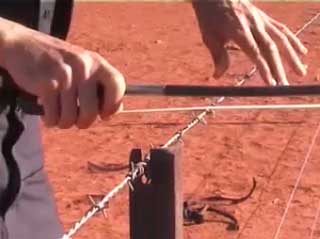
How to play music with barbed wire and chainsaws
And here he is conducting an orchestra made up of violinists, a drummer, a pianist and several chainsaw players. There's a lot more interesting stuff, including a MIDI bow being demonstrated on daytime TV, at this page. (Thanks Sam)
http://musicthing.blogspot.com/2006/12/how-to-play-music-with-barbed-wire-and_30.html
powered by performancing firefox