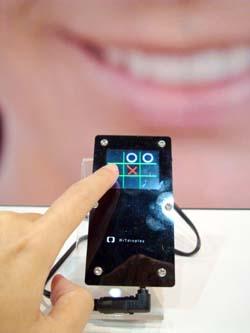
http://singularityhub.com/2009/04/09/3d-printing-and-self-replicating-machines-in-your-living-room-seriously/


Formed sometime between January and September 2008, this fresh crater has dredged up barely buried water ice and splashed it onto the Martian surface. The HiRISE camera aboard NASA's Mars Reconnaissance Orbiter recorded this colour close-up image on 1 November 2008. The scene is about 30 metres across. (Image: NASA/JPL/University of Arizona)

A miniature telescope implanted into the eye could soon help people with vision loss from end-stage macular degeneration. Last week, an advisory panel for the Food and Drug Administration unanimously recommended that the agency approve the implant. Clinical trials of the device, which is about the size of a pencil eraser, suggest it can improve vision by about three and a half lines on an eye chart.
"This is one of the few options for people with end-stage macular degeneration," says Kathryn Colby, an eye surgeon at the Massachusetts Eye and Ear Infirmary, in Boston, who helped develop the surgical procedure used to implant the device.
http://www.technologyreview.com/biomedicine/22378/


"We were studying making hydrogen in microbial electrolysis cells and we kept getting all this methane," said Bruce E. Logan, Kappe Professor of Environmental Engineering, Penn State. "We may now understand why."
Methanogenic microorganisms do produce methane in marshes and dumps, but scientists thought that the organisms turned hydrogen or organic materials, such as acetate, into methane. However, the researchers found, while trying to produce hydrogen in microbial electrolysis cells, that their cells produced much more methane than expected.
"All the methane generation going on in nature that we have assumed is going through hydrogen may not be," said Logan. "We actually find very little hydrogen in the gas phase in nature. Perhaps where we assumed hydrogen is being made, it is not."
Microbial electrolysis cells do require an electrical voltage to be added to the voltage that is produced by bacteria using organic materials to produce current that evolves into hydrogen. The researchers found that the Archaea, using about the same electrical input, could use the current to convert carbon dioxide and water to methane without any organic material, bacteria or hydrogen usually found in microbial electrolysis cells. They report their findings in this week's issue of Environmental Science and Technology.
"We have a microbe that is self perpetuating that can accept electrons directly, and use them to create methane," said Logan.
March 29, 2009
UPTON, NY — Building on the idea of using DNA to link up nanoparticles — particles measuring mere billionths of a meter — scientists at the U.S. Department of Energy’s (DOE) Brookhaven National Laboratory have designed a molecular assembly line for predictable, high-precision nano-construction. Such reliable, reproducible nanofabrication is essential for exploiting the unique properties of nanoparticles in applications such as biological sensors and devices for converting sunlight to electricity. The work will be published online March 29, 2009, by Nature Materials.
http://www.bnl.gov/cfn/news/PRdisplay.asp?prID=921


The fridge was developed by mechanic engineering students Frederik Knop, Nicolás Ripoll, and Olivier Bernade, the last one a French exchange student.
The prototype is based on adsorption, which Wikipedia explains in the following way:
Absorptive refrigeration uses a source of heat to provide the energy needed to drive the cooling process.[...] The classic gas absorption refrigerator sends liquid ammonia into a hydrogen gas. The liquid ammonia evaporates in the presence of hydrogen gas, providing the cooling. The now-gaseous ammonia is sent into a container holding water, which absorbs the ammonia. The water-ammonia solution is then directed past a heater, which boils ammonia gas out of the water-ammonia solution. The ammonia gas is then condensed into a liquid. The liquid ammonia is then sent back through the hydrogen gas, completing the cycle.
![]()
http://www.treehugger.com/files/2009/03/new-solar-refrigerator-prototype-from-chile.php

The Hubble observations suggest the erstwhile star was a luminous blue variable, a massive star at least 50 times as heavy as the Sun that jettisons most of itself material into space in a series of outbursts. Eta Carinae, wedged between gigantic hourglass-shaped clouds of material that it sloughed off, is a classic example of this kind of star.
That classification was surprising, since luminous blue variables were not expected to explode. Stellar models predict that the stars should evolve further – into other stellar types, shedding all of the hydrogen on their surfaces and most of their mass, before running out of fuel and going supernova.
But "our star when it exploded still had some of its hydrogen envelope. It seems to have exploded before its time," says team member Douglas Leonard of San Diego State University in California.

CHICAGO (Reuters) - U.S. engineers have found a way to make lithium batteries that are smaller, lighter, longer lasting and capable of recharging in seconds.
The researchers believe the quick-charging batteries could open up new applications, including better batteries for electric cars.
And because they use older materials in a new way, the batteries could be available for sale in two to three years, a team from Massachusetts Institute of Technology reported on Wednesday in the journal Nature.
Current rechargeable lithium batteries can store large amounts of energy, making them long-running. But they are stingy about releasing their power, making them discharge energy slowly and require hours to recharge.
Scientists traditionally have blamed slow-moving lithium ions -- which carry charge across the battery -- for this sluggishness.
However, about five years ago, Gerbrand Ceder and a team at MIT discovered that lithium ions in traditional lithium iron phosphate battery material actually move quite quickly.
"It turned out there were other limitations," Ceder said in a telephone interview.
Ceder and colleagues discovered that lithium ions travel through tunnels accessed from the surface of the material. If a lithium ion at the surface is directly in front of a tunnel entrance, it can quickly deliver a charge. But if the ion is not at the entrance, it cannot easily move there, making it less efficient at delivering a charge.
Ceder and colleagues remedied this by revamping the battery recipe. "We changed the composition of the base material and we changed the way it is made -- the heat treatment," Ceder said.
This created many smooth tunnels in the material that allow the ions to slip in and out easily. "The trick was knowing what to change," he said.
Using their new processing technique, the team made a small battery that could be fully charged in 10 to 20 seconds.
Ceder thinks the material could lead to smaller, lighter batteries because less material is needed for the same result.
And because they simply tinkered with a material already commonly used for batteries, it could be easily adapted for commercial use.
"If manufacturers decide they want to go down this road, they could do this in a few years," Ceder said.
http://tech.yahoo.com/news/nm/20090311/tc_nm/us_batteries_3


Researchers at Sandia National Laboratories, in Livermore, CA, have created the first carbon-nanotube devices that can detect the entire visible spectrum of light. Their work might one day find a range of applications, including in solar cells that absorb more light, tiny cameras that work in very low light, and better artificial retinas.
Other researchers have demonstrated nanotubes that can detect light of specific wavelengths, including ultraviolet light, but never the entire visible spectrum of light. "This is a significant milestone," says George Grüner, a professor of physics and head of the Nano-Biophysics Group at the University of California, Los Angeles, who was not involved in the Sandia work.
The light sensor inside a digital camera--known as a charge-coupled device--converts light into an electrical signal because as photons bombard silicon, they create electron holes in the material. In contrast, carbon-nanotube light sensors work in a similar way to biological eyes. The nanotubes are decorated with three kinds of chromophores--molecules that change shape in response to a particular wavelength of light. This change in shape results in a change in the chromophores' orientations with respect to the nanotube that, in turn, changes the electrical conductivity of the nanotube in a way that can be measured to deduce the color and intensity of the light. The Sandia researchers used three different types of chromophores, which respond to either red, green, or blue bands of the visible-light spectrum.
The work is still at an early stage, but nanotube light sensors could have advantages over today's light-sensing chips. Most important, says Sandia researcher Xinjian Zhou, the devices are intrinsically high resolution and small. Their resolution is the same as the diameter of each nanotube--about one nanometer. And because an array of the nanotubes could be very small, light could be focused into a very small area, meaning that future devices would be very sensitive to low light levels. Also, nanotube light sensors could be printed on flexible polymer backings. This could make them cheaper to manufacture and also less irritating to biological tissue--an important consideration for retinal implants.


Scientists at Edmonton's National Institute for Nanotechnology have
made a significant breakthrough that could help pave the way for new
generations of smaller, more energy-efficient computers.
The
team, led by Robert Wolkow, has invented the world's smallest quantum
dots, atom-sized devices capable of controlling electrons, using a
fraction of the power of current computer technology.
"Roughly
speaking, we predict there could be a 1,000-time reduction in power
consumption with electronic computers built in this new way," said
Wolkow, a physicist at the University of Alberta.
"And they could
be something like 1,000 times smaller in size. So it's reaching the
very limit as far as anyone could imagine of how small things could
get."
The team's work is published in the latest edition of Physical Review Letters, considered the world's premier physics journal.
Current
computers use transistors, which are essentially valves for flowing
streams of electrons around a circuit. In recent years, engineers have
found ways to make these devices smaller, but pushing electrons through
narrow spaces raises the danger of the machines overheating and failing.
"So the problem is no longer how do we make it smaller, it's how do we consume less power," Wolkow said.

Are you one of the biggest nerds in the world? If so, you probably know the fake Klingon language from Star Trek.
And maybe you want to write things in this fake tongue. But here you
are stuck with a stupid English keyboard. What to do? Buy a keyboard
with Klingon symbols on it, that's what!
Not only does this keyboard let you type in a made-up language, but
it also connects with a PS/2 cable, something no current computers use.
So to recap: if you're a super nerd with an old computer and you want
to type in Klingon, you can buy this warrior's accessory here.
For the other 99.99999999% of the world, we'll stick to regular
keyboards. And for the precious few of us who might need their Klingon
fix now and then, stick to online Klingon translators.
http://dvice.com/archives/2009/01/klingon_keyboar.php
The unequivocal signature of water vapor has been found on a
planet beyond our solar system.
Using NASA's Spitzer Space Telescope,
astronomers detected
the steamy signature of water vapor in the light coming from a large
exoplanet circling around a star about 63 light-years from Earth.
Though it's not the first sign of water vapor around this planet, it's
the strongest evidence yet.
The planet, HD 189733b, is what's called a "Hot Jupiter" — a boiling,
gigantic gas planet more akin to our own Jupiter or Saturn than to a
terrestrial planet like Earth. It's not a good candidate itself for alien
life, but the successful detection of water vapor here, in the
location and quantities that theorists predicted, bodes well for further
studies of more promising locales for extraterrestrial life.
"It means we're starting to understand these objects a
little bit better than we did when we first started," astrophysicist Adam
Burrows of Princeton University told Wired.com. "It’s a trial run for the
much more detailed investigations that will be possible in the years to come as
we take this stepping stone from giant planets to terrestrial planets."
Though water vapor is thought to be fairly common on planets — even
our own Jupiter has it — the discovery of its presence on another world
is significant and points the way toward future discoveries, scientists
say. Yesterday scientists announced that the Hubble Space Telescope
had found carbon dioxide, which under the right circumstances could be
connected to life, on the same planet. The presence of methane has also
been detected.
http://blog.wired.com/wiredscience/2008/12/embargoed---wat.html
LIFE, an acronym for Laser Inertial Fusion-Fission Energy, is an advanced energy concept under development at Lawrence Livermore National Laboratory (LLNL).
He wrote a program that would randomly place shapes on a black
background, and decide whether the abstract pattern looked more or less
like the famous painting. After almost a million tries, the program's
output had evolved to the point where Alsing had the image on the far
right.
http://io9.com/5106124/a-computer-program-that-taught-itself-to-draw-the-mona-lisa
The
research team at the Max Planck Institute for Evolutionary Anthology
presented their findings last week at a human evolution conference. The
researchers have compared the Neanderthal genome to that of modern
humans of European and African descent. Because Neanderthals and modern
humans coexisted in Europe, researchers have theorized that European
genomes would have more similarities with the Neanderthal genome than
would African genomes. However, European and African genomes have a
similar number of differences from the Neanderthal genome, suggesting
that modern humans in Europe outbred rather than assimilated the
Neanderthals.

http://io9.com/5105912/no-neanderthal-ancestors-for-modern-humans
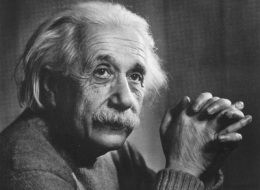
PARIS (AFP) - It's taken more than a century, but Einstein's
celebrated formula e=mc2 has finally been corroborated, thanks to a
heroic computational effort by French, German and Hungarian physicists.
A brainpower consortium led by Laurent Lellouch of France's Centre
for Theoretical Physics, using some of the world's mightiest
supercomputers, have set down the calculations for estimating the mass
of protons and neutrons, the particles at the nucleus of atoms.
According to the conventional model of particle physics, protons and
neutrons comprise smaller particles known as quarks, which in turn are
bound by gluons.
The odd thing is this: the mass of gluons is zero and the mass of
quarks is only five percent. Where, therefore, is the missing 95
percent?
The answer, according to the study published in the US journal Science on Thursday, comes from the energy from the movements and interactions of quarks and gluons.
In other words, energy and mass are equivalent, as Einstein proposed in his Special Theory of Relativity in 1905.
The e=mc2 formula shows that mass can be converted into energy, and energy can be converted into mass.
By showing how much energy would be released if a certain amount of
mass were to be converted into energy, the equation has been used many
times, most famously as the inspirational basis for building atomic
weapons.
But resolving e=mc2 at the scale of sub-atomic particles -- in equations called quantum chromodynamics -- has been fiendishly difficult.
"Until now, this has been a hypothesis," France's National Centre for Scientific Research (CNRS) said proudly in a press release.
"It has now been corroborated for the first time."
http://news.yahoo.com/s/afp/20081120/sc_afp/sciencephysicseinstein_081120235605??
A nearby solar system bears a striking similarity to our own solar system, raising the possibility it could harbor Earth-like planets.
Epsilon Eridani, located about 10.5 light-years from our sun, is surrounded by two asteroid belts that are shaped by planets, astronomers at SETI Institute and Harvard-Smithsonian Center for Astrophysics announced today.But it's the possibility that currently undetected smaller planets could lie within the innermost asteroid belt that make the solar system intriguing to astrobiologists.
"This system probably looks a lot like ours did when life first took root on Earth," said SETI's Dana Backman, lead author of a paper on the 850-million-year-old star that will appear next year in The Astrophysical Journal, in a release.Back then, the Kuiper Belt of space objects beyond Neptune was much larger. Over time, many of those objects fell into the inner solar system during a period about four billion years ago known as the Late Heavy Bombardment. The barrage of large asteroids pockmarked the rocky planets and possibly created our moon when a large object collided with Earth, expelling a huge amount of material into space.
Epsilon Eridani's evolution could provide insight into how universal these processes are. That's important because our solar system contains a planet — Earth — just far enough from the sun not to be fried but close enough to capture enough energy to support life as we know it. Similar systems
could end up with planets orbiting in the same biological sweet spot.
A nearby solar system bears a striking similarity to our own solar
system, raising the possibility it could harbor Earth-like planets.
Epsilon Eridani, located about 10.5 light-years from our sun, is surrounded by two asteroid belts that are shaped by planets, astronomers at SETI Institute and Harvard-Smithsonian Center for Astrophysics announced today.
But it's the possibility that currently undetected smaller planets could lie
within the innermost asteroid belt that make the solar system intriguing to astrobiologists.
"This system probably looks a lot like ours did when life first took root on Earth," said SETI's Dana Backman, lead author of a paper on the 850-million-year-old star that will appear next year in The Astrophysical Journal, in a release.
Back then, the Kuiper Belt
of space objects beyond Neptune was much larger. Over time, many of
those objects fell into the inner solar system during a period about
four billion years ago known as the Late Heavy Bombardment.
The barrage of large asteroids pockmarked the rocky planets and
possibly created our moon when a large object collided with Earth,
expelling a huge amount of material into space.
Epsilon Eridani's evolution could provide insight into how universal these processes are.
That's important because our solar system contains a planet — Earth —
just far enough from the sun not to be fried but close enough to
capture enough energy to support life as we know it. Similar systems
could end up with planets orbiting in the same biological sweet spot.
We use high-definition television, dark rooms, and surround sound to create an immersive media experience. But for those who want television that more closely resembles the holodeck, there’s good news. A University of Arizona research team has made a significant breakthrough in 3-D displays that could put holographic sets on the market in five to ten years."This is a prerequisite for any type of moving holographic technology. The way it works presently is not suitable for 3-D images," he said.The researchers produced displays that can be erased and rewritten in a matter of minutes.
According to Peyghambarian, they could be constructed as a screen on the wall (like flat panel displays) that shows 3-D images, with all the image writing lasers behind the wall; or it could be like a horizontal panel on a table with holographic writing apparatus underneath.
So, if this project is realized, you really could have a football match on your coffee table, or horror-movie villains jumping out of your wall.
"It's as if Earth and Venus collided with each other," said Benjamin"If any life was present on either planet, the massive collision
would have wiped out everything in a matter of minutes — the
ultimate extinction event," said co-author Gregory Henry, an astronomer
at Tennessee State University (TSU). "A massive disk of
infrared-emitting dust circling the star provides silent testimony to
this sad fate."
http://www.sciencedaily.com/releases/2008/09/080923164646.htm


You've seen the Noah, marveled at the Embrio
— isn't it time you saw a one-wheeled motorcycle that might
actually be real? Witness the UnoCycle, a single-wheel, single-rider
(please don't test that limit) vehicle that appears to be based on
gyroscopic tech similar to a Segway and, more importantly, has
photographic evidence of its existence. Of guys riding it and
everything.
Still in development, the Uno's top speed is 15 mph, but the
inventor, Ben Gulak, suspects it could go as high as 40. That's no
Harley, but it's faster than a Segway, and remember this is a
battery-powered machine that you never need to fill up. Gulak says he's
getting lots of interest lately — we hope he invests a little of
his incoming finances into a less-skeletal website.

| |
"The LED technology has the potential of
replacing all incandescent and compact fluorescent bulbs, which would
have dramatic energy and environmental ramifications," said Timothy D.
Sands, the Basil S. Turner Professor of Materials Engineering and
Electrical and Computer Engineering.
The LED lights are about as efficient as compact fluorescent lights, which contain harmful mercury.
THAT problem solving becomes easier when more minds are put to the task is no more than common sense. But the phenomenon goes further than that. Ask two people to answer a question like “how many windows are there on a London double-decker bus” and average their answers. Their combined guesses will usually be more accurate than if just one person had been asked. Ask a crowd, rather than a pair, and the average is often very close to the truth. The phenomenon was called “the wisdom of crowds” by James Surowiecki, a columnist for the New Yorker who wrote a book about it. Now a pair of psychologists have found an intriguing corollary. They have discovered that two guesses made by the same person at different times are also better than one.
That is strange. Until now, psychologists have assumed that when people make a guess, they make the most accurate guess that they can.Ask them to make a second and it should, by definition, be less accurate. If that were true, averaging the first and second guesses should decrease the accuracy. Yet Edward Vul at the Massachusetts Institute of Technology and Harold Pashler at the University of California, San Diego, have revealed in a study just published in Psychological Science that the average of first and second guesses is indeed better than either guess on its own.
The two researchers asked 428 people eight questions drawn from the “CIA World Factbook”: for example, “What percentage of the world’s airports are in the USA?” Half the participants were unexpectedly asked to make a second, different guess immediately after they completed the initial questionnaire. The other half were asked to make a second guess three weeks later.
Dr Vul and Dr Pashler found that in both circumstances the average of the two guesses was better than either guess on its own. They also noticed that the interval between the first and second guesses determined how accurate that average was. Second guesses made immediately improved accuracy by an average of 6.5%; those made after three weeks improved the accuracy by 16%.http://www.economist.com/science/displaystory.cfm?story_id=11614183
Futurologists envision a world a million years from now in which the entire solar system has been turned into computronium
and nanobots transform our garbage into foie gras. But in my
experience, the repeated sin of futurologists is that they often
extrapolate from what is new rather than from what is old. Computers
and nanotechnology, impressive though they are, are things of
relatively recent origin. As such, they are unlikely to be around for
very long.
To find something that will pretty certainly endure into the distant
future, we are obliged, paradoxically enough, to go back much farther
into the past. And if we could cast a look back several million years,
we would see, among other things, laughter and numbers. So we can be
pretty confident that laughter and numbers will survive long after most
of what we’re familiar with is gone.
The insight that old things tend to last and new things tend to disappear flows from the Copernican principle.
This principle says, in essence, “You’re not
special.” Before Copernicus, we imagined that we occupied a very
special place at the center of the universe. Now we know better: We are
on an average planet in an average galaxy in an average cluster. But
the Copernican principle applies to time as well as to space. If there
is nothing special about our perspective, we are unlikely to be
observing any given thing at the very beginning or the very end of its
existence. And that rather obvious point can lead to some interesting
predictions.
Consider the longevity of the human race. If there is nothing
special about the moment at which we observe our species, then it is 95
percent certain that we are seeing Homo sapiens in the middle 95
percent of its existence—not the first fortieth (2½
percent) or the last fortieth (2½ percent). Humans have already
been around for about 200,000 years. That means we can, with 95 percent
confidence, expect the species to endure for at least another 5,100
years (1/39 x 200,000) but for no more than 7.8 million years (39 x
200,000).
It was Richard Gott III, an astrophysicist at Princeton University,
who pioneered this sort of reasoning. In a paper published in Nature on
May 27, 1993, “Implications of the Copernican Principle for Our Future Prospects,”
Gott noted that the Copernican-based calculation gives H. sapiens an
expected total longevity comparable to that of other hominid species
(H. erectus lasted 1.6 million years) and of mammal species in general
(whose average span is 2 million years). It also gives us a decent shot
at being around a million years from now.
What else might be around in the Year Million? Consider something of
recent origin, like the Internet. The Internet has existed for about 25
years now (as I learned by going on the Internet and looking at Wikipedia).
By Copernican reasoning, this means we can be 95 percent certain that
it will continue to be around for another seven-plus months but that it
will disappear within 975 years. So in the Year Million, there will
almost certainly be nothing recognizable as the Internet. (This is,
perhaps, not a terribly surprising conclusion.) Ditto for baseball.
Ditto for what we call industrial technology, which, having come into
existence a little more than two centuries ago, is likely to be
superseded by something strange and new in the next 10,000 years.
Historians typically trace the origins of the World Wide Web through
a lineage of Anglo-American inventors like Vannevar Bush, Doug
Engelbart and Ted Nelson. But more than half a century before Tim
Berners-Lee released the first Web browser in 1991, Otlet (pronounced
ot-LAY) described a networked world where “anyone in his armchair
would be able to contemplate the whole of creation.”
Although
Otlet’s proto-Web relied on a patchwork of analog technologies
like index cards and telegraph machines, it nonetheless anticipated the
hyperlinked structure of today’s Web. “This was a Steampunk
version of hypertext,” said Kevin Kelly, former editor of Wired,
who is writing a book about the future of technology.


Punching your way out of a paper bag could become a lot harder,
thanks to the development of a new kind of paper that is stronger than
cast iron.
The
new paper could be used to reinforce conventional paper, produce
extra-strong sticky tape or help create tough synthetic replacements
for biological tissues, says Lars Berglund from the Swedish Royal Institute of Technology in Stockholm, Sweden.
Despite
its great strength, Berglund's "nanopaper" is produced from a
biological material found in conventional paper: cellulose. This long
sugar molecule is a principal component of plant cell walls and is the
most common organic compound on Earth.
Wood is typically about half cellulose, mixed with other structural compounds.
In
plant cell walls individual cellulose molecules bind together to
produce fibres around 20 nanometres in diameter, 5000 times thinner
than a human hair. These fibres form tough networks that provide the
cell walls with structural support.
"Cellulose
nanofibres are the main reinforcement in all plant structures and are
characterised by nanoscale dimensions, high strength and toughness,"
Berglund told New Scientist.
Cellulose
is extracted from wood to make paper, is the basis of cellophane, and
has also recently been used by materials scientists developing novel
plastic materials. But they have used it only as a cheap filler
material, ignoring its mechanical properties.
However,
the mechanical processes used to pulp wood and process it into paper
damage the individual cellulose fibres, greatly reducing their
strength. So Berglund and colleagues have developed a gentler process
that preserves the fibres' strength.
The
new method involves breaking down wood pulp with enzymes and then
fragmenting it using a mechanical beater. The shear forces produced
cause the cellulose to gently disintegrate into its component fibres.
The
end result is undamaged cellulose fibres suspended in water. When the
water is drained away Berglund found that the fibres join together into
networks held by hydrogen bonds, forming flat sheets of "nanopaper".
Mechanical
testing shows it has a tensile strength of 214 megapascals, making it
stronger than cast iron (130 MPa) and almost as strong as structural
steel (250 MPa).
Normal
paper has a tensile strength less than 1 MPa. The tests used strips 40
millimetres long by 5mm wide and about 50 micrometres thick.
The telectroscope, a looking-glass tunnel connecting New York and
The telectroscope's inventor, St. George, was passionately committed to
the idea of being able to connect London and New York without having to
move. He constructed parts of a great shaft which unfortunately
collapsed on many of his workers in 1892. The project was never
completed. His ancestor Paul St. George stumbled upon the original
blueprints and details and brought the telectroscope to life.
ScienceDaily (Mar. 17, 2008)
— A new mathematical object was revealed yesterday during a lecture at the American Institute of Mathematics (AIM). Two researchers from the University of Bristol exhibited the first example of a third degree transcendental L-function. These L-functions encode deep underlying connections between many different areas of mathematics.
The news caused excitement at the AIM workshop attended by 25 of the world's leading analytic number theorists. The work is a joint project between Ce Bian and his adviser, Andrew Booker. Booker commented that, "This work was made possible by a combination of theoretical advances and the power of modern computers." During his lecture, Bian reported that it took approximately 10,000 hours of computer time to produce his initial results.
"This breakthrough opens a door to the study of higher degree L-functions," said Dennis Hejhal, Professor of Mathematics at the University of Minnesota and Uppsala University.
"It's a big advance' added Harold Stark of the University of California, San Diego, who, 30 years ago was the first to accurately calculate second degree transcendental L-functions.
"I thought we were years away from doing this. The geometry of what you have to do and the scale of the computation are orders of magnitude harder."
There are two types of L-functions: algebraic and transcendental, and these are classified according to their degree. The Riemann zeta-function is the grand-daddy of all L-functions. It holds the secret to how the prime numbers are distributed, and is a first-degree algebraic L-function.
http://www.sciencedaily.com/releases/2008/03/080313124415.htm
Brad DeLong once said that "'Nobody could have foreseen ______' is
the Bush administration's version of 'The dog ate my homework.'" It
does seem to be their handy-dandy Swiss Army Knife, all-purpose
explanation for the various disasters that have happened on their
watch.
We first heard this excuse all the way back in May 2002, when
Condoleezza Rice blithely dismissed Congressional queries about 9/11 by
saying, "I don't think anybody could have predicted that these people
would take an airplane and slam it into the World Trade Center, take
another one and slam it into the Pentagon; that they would try to use
an airplane as a missile, a hijacked airplane as a missile."
A nation of Tom Clancy fans — and those who remembered Sam
Byck's too-close-for-comfort White House flyover back in the 70s
— wondered what on God's green earth these idiots were thinking.
But the Bushies decided they were onto something.
In fact, they liked this excuse so much that they trotted it out
again after Katrina. As New Orleans' Ninth Ward vanished under the mud
of Lake Ponchartrain, W went on the national airwaves to insist, "I
don't think anybody anticipated the breech of the levees."
That was wrong, too, of course: everyone from the City of New
Orleans to the Army Corps of Engineers had seen this one coming for
decades. In fact, the New Orleans Times-Picayne had done an entire
series on just this subject as recently as 2002. You’d think that
the coast-to-coast derision that followed might have alerted Bush and
crew they were reaching for an excuse that no self-respecting
third-grader would touch.
<a href='http://www.ourfuture.org/blog-entry/stealing-our-future-conservatives-foresight-and-why-nothing-works-anymore'>link</a>
Powered by ScribeFire.
<a href='http://dvice.com/archives/2008/01/horrors_of_desi_1.php'>link</a>Powered by ScribeFire.
Powered by ScribeFire.